The Lesbian Body
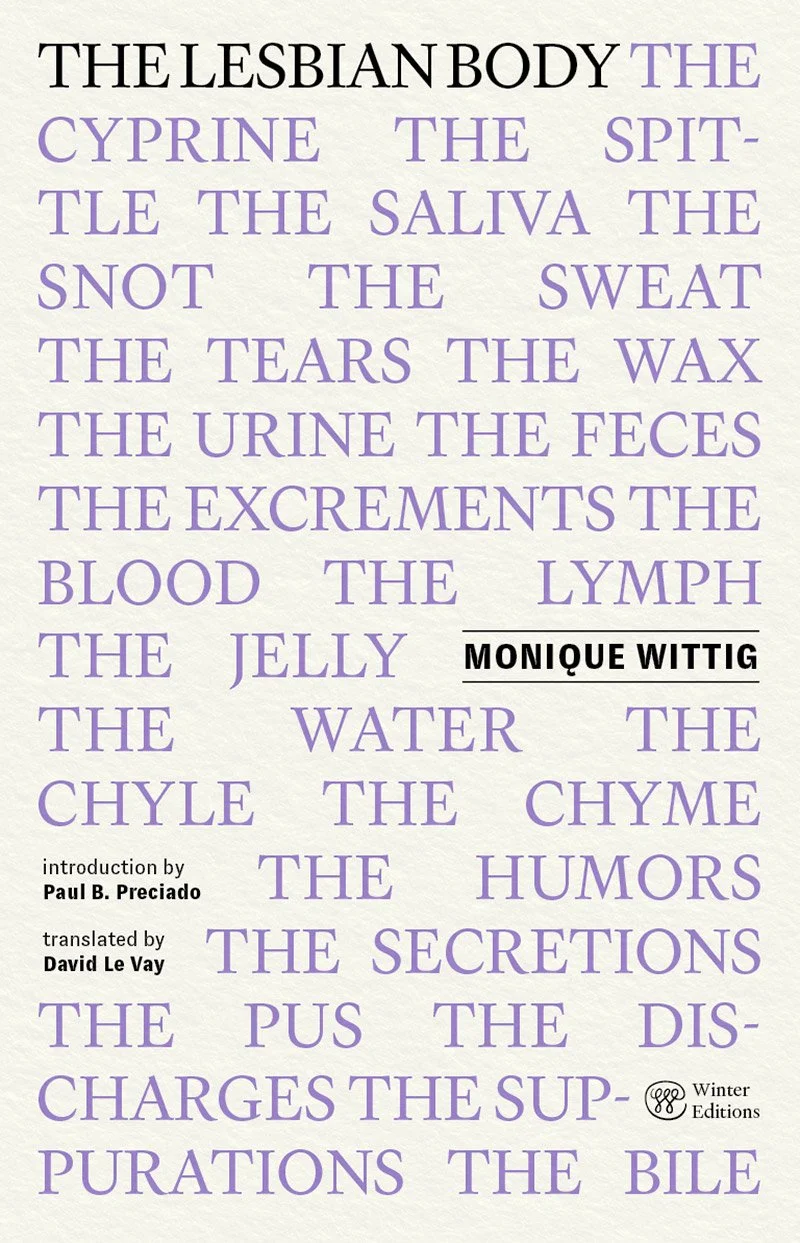
Monique Wittig
The Lesbian Body
Translated by David Le Vay
Introduction by Paul B. Preciado
In this genre- and gender-breaking work of theory-fiction, legendary writer and cofounder of the 1970s French feminist movement Monique Wittig celebrates the body—lesbian, literary and defiantly political—and challenges the order of heterosexuality in literature.
First published in French in 1973, The Lesbian Body mines the relationship between a lover and a beloved—also a writer and a text—to explore the ideological and historical constructions of the female subject. Organized according to the principle of montage, poetic passages are juxtaposed with anatomic lists that mark lesbian eros. Through expressions of joy, violence, and tenderness, the site of pleasure is celebrated. In her transfiguration of gender and its paradigms, Wittig transformed French vocabulary, feminizing grammar and lesbianizing myths. This edition brings the English translation of Wittig’s groundbreaking work back into circulation for the first time since the mid-1980s, revised according to the author's notes, and with an introduction by Paul B. Preciado.
“For me, Wittig opened up a sense of the world that had been, quite literally, unimaginable. She tore us apart.”
—Judith Butler
The Lesbian Body is a fundamental work of lesbian existence. Wittig's applied vision is a state of natural delirium, a revolutionary excess of utopianism, refusal, and mutual self-creation. Revisiting it reveals how much passionate free thought has been lost, and simultaneously, how many of her tropes and discoveries have integrated into our collective consciousness.
—Sarah Schulman
In this stunning new rendering of The Lesbian Body by the French author, theorist, activist and teacher, the late Monique Wittig, we are plunged into an imagined world of passionate violence and erotic lesbian mayhem intertwined in strikingly bold poetic images. Wittig, in the reach and volatility of her imagination, stands alongside such important American writers as Audre Lorde, Adrienne Rich, and Valerie Solanas, all of whose work deserves to be read again, or for the first time.
—Esther Newton
Refusing the versions of woman, lesbian and female that have been relegated to support systems or reduced to breasts and pussies or cast as abject versions of some elevated principle of manliness, The Lesbian Body explodes all the clichés associated with femininity and lesbianism and transforms the bodies of the lover and the beloved into a raucous, violent, lustful catalog of unbecoming. Using and naming every part of the body—spleen, duodenum, eyelids—the lover seeks to obliterate and be obliterated by the desire that arcs back and forth between her and the beloved. These women live by night, love by day and unmake the world that cast them out. To read the book is to be forced by Wittig into another grammar and happily contaminated by its strange forms. You will never think straight again.
Together with Ursula Le Guin and Samuel R. Delany, Wittig is the first to design a nonbinary utopia, a world in which the binary categorization of sexes and genders will have ceased to exist. Each and everybody that is ready to walk the path of radical emancipation will become a Lesbian Body.
—Paul B. Preciado
Novelist, poet, theorist, and activist, Monique Wittig (1935–2003) burst onto the literary scene with her novel, The Opoponax, in 1964, which won the Medicis Prize and the attention of writers of the French New Wave. Her second novel, Les Guérillères, was written against the backdrop of the May 1968 student and worker revolt. In 1970, she co-founded the Women’s Liberation Movement (MLF) in France and penned its manifesto. Despite her activism, Wittig was sidelined from the MLF due to her resolute advocacy of lesbianism within materialist feminist discourse. In the mid-’70s, soon after publishing the formally radical The Lesbian Body, Wittig relocated to the United States with her partner, Sande Zeig, with whom she co-wrote Lesbian Peoples: Material for a Dictionary. Living in Northern California, she wrote the novel Across the Acheron, the political essays collected in The Straight Mind and Other Essays, a novella, a play, and two film scripts. She taught as a visiting professor at a variety of colleges, later joining the faculty of the University of Arizona. Widely published from the 1960s to the 1990s, her work is now animating a new wave of feminist and queer thought.
Paul B. Preciado is the author of Dysphoria Mundi, Can the Monster Speak?, An Apartment on Uranus, Counter-Sexual Manifesto, and Testo Junkie, among other books, and wrote and directed the film Orlando, My Political Biography. He is the Director of the Institute for Planetary Transition at LUMA Arles, France. He was born in Spain and lives in France.
David Le Vay (1915–2001) was a British surgeon, translator, and author of several biographies and popular science textbooks. He translated numerous scientific and literary works from French, German, Spanish, and Latin, including books by Monique Wittig, Joseph Roth, and Colette.
Paperback
216 Pages
5.12 x 7.95 inches
Edition of 4000
ISBN 978-1-959708-16-2
November 5, 2025
English
Distributed by Asterism Books (US) • Public Knowledge Books (UK)
Genre: Fiction