Revolutions Among Us
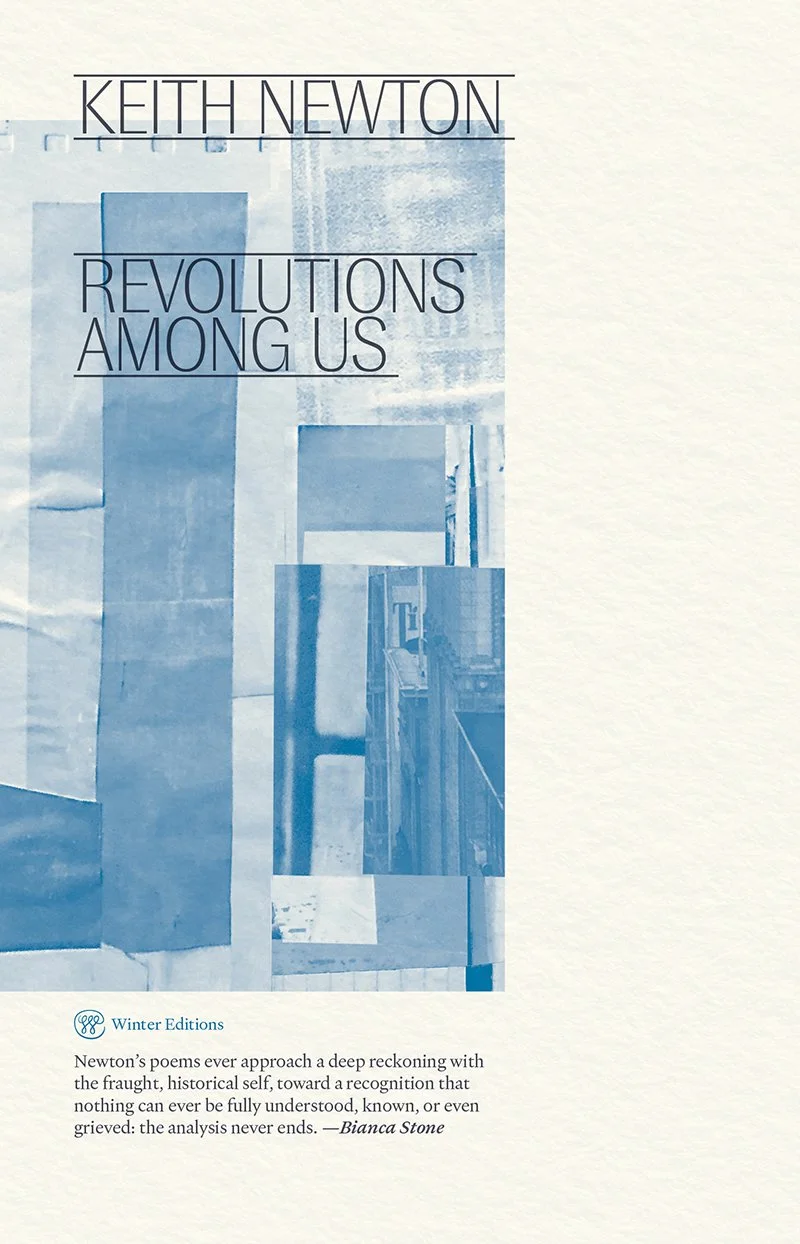
Out of the crises of our moment, Keith Newton's first book of poems roams across time to explore our conflict with forces larger than ourselves.
$20.00
November 2026
ISBN 978-1-959708-21-6
Read Sample
Keith Newton
Revolutions Among Us
Out of the crises of our moment, Keith Newton's first book of poems roams across time to explore our conflict with forces larger than ourselves.
Moving from the elegiac to the cinematic to the essayistic, the poems in Revolutions Among Us draw on the many forms the past can take, as personal history diverges from collective memory. Newton's childhood in a psychotherapy cult in New York informs the book's struggles with belief and ideology, indoctrination and control, questioning our ability to interpret the world around us or to disentangle our thoughts and desires from those of others.
If a single sentence could describe a human life, it would be this one: “Once again you’re alone in these investigations, and the point, as usual, is not to lose your way.” There is an eeriness to these metaphysical reflections, as if Newton has succeeded in drawing a map of the inside of an ever-questioning mind. The end goal isn’t a place or even a state but the sense of knowing and of having been known. I would, if I could, quote every line of these intriguing poems.
—Mary Jo Bang
“There are revolutions among us,
/ but no names for what’s been overturned,” writes Keith Newton, thereby naming a feature of post-war capitalist America and its ongoing admixture of distracted desire and moral malaise. For Newton, the poem offers an “instrument” to map small and large histories, even if it's simply to discover a detail that stayed disorientation. Here, there is always “a word to enter, a former name.”
—Christian Hawkey
Inhabiting a psychic space where the “I” has been stripped of autonomous identity, Keith Newton claims, “I am a stranger like other strangers.” Except—this poet, a virtuoso at creating narratives while simultaneously shattering them, reveals that like history embedded in architecture, meaning insists on radiating past the edges of structures that attempt to control it. Here, in the “garden where every path leads to a folly,” among impasses, rumors, and evasions, we find poetry articulating what, by other forms of communication, is refused utterance.
—Karla Kelsey
Keith Newton’s inexorable and exquisite collection begins in prose, like letters arriving un-enveloped within the psyche. With an interchangeable first and second person address, we rehearse together the complexes of identity within the public and private domain—and thus the poems ever approach a deep reckoning with the fraught, historical self. It is, as one poem begins, “a process of steady disillusion.” Linearity comes with fierce adherence to the tone of the poems, in endless surprising leaps of language. Revolutions Among Us is procedural lyricism, guided by a speaker living in the shadow of something disastrous. This formative, inherited error liberates the poems toward a recognition that nothing can ever be fully understood, known, or even grieved: the analysis never ends.
—Bianca Stone
Near the end of Revolutions Among Us, Keith Newton writes of Shostakovich’s fifth symphony that “When you grow up in the shadow of a failed idea, the end of every idea is failure.” Just as that symphony is both a work of exuberance & a forced march, Newton finds our world layered with shadows from which we must build sympathies & joys, knowing in advance they too will fail, & further knowing that failure doesn’t make joy less joyful, nor less honest. This book wrings hope & understanding from the shadows. Some poems speak in an almost-oracular collective consciousness, in which the testimony of dreams seems bent on evolving into desire's myths of state, & only the sentence can resist it. Some speak from Newton’s lived experience, situating himself amid ever-present revolutions. But the book consistently acknowledges how we are responsible, even in shadow, for joy, for ourselves, for one another. Revolutions Among Us is a light left on in an upstairs window so the reader might know which house is home.
—Mathias Svalina
Keith Newton is a writer, editor, and filmmaker based in Brooklyn. He is one of the creators of the documentary series The Fourth Wall—premiered at the Tribeca Festival in 2023—an investigation into the New York–based psychotherapy cult known as the Sullivanians, in which Newton was raised until he was seventeen. He studied writing at Northwestern University and received an MFA from Washington University in St. Louis. His writing has appeared in Denver Quarterly, Harvard Review, and 1913, among others, and he edits the online literary magazine Harp & Altar. He is the author of poetry chapbooks from Cannibal Books and Berl’s as well as a short work of prose from Essay Press based on the collages of Max Ernst.
Paperback
88 Pages
5.12 x 7.95 inches
Edition of 1250
ISBN 978-1-959708-21-6
November 5, 2026
English
Distributed by Asterism Books (US) • Public Knowledge Books (UK)
Genre: Poetry