In a tour-de-force of one hundred sonnets, Rodrigo Toscano blends geopolitical critique with the challenges of media-saturated life, offering a sharp, sustaining read for those overwhelmed by the twenty-first century’s complexities.
$22.00
November 2026
ISBN 978-1-959708-23-0
Read Sample
Rodrigo Toscano
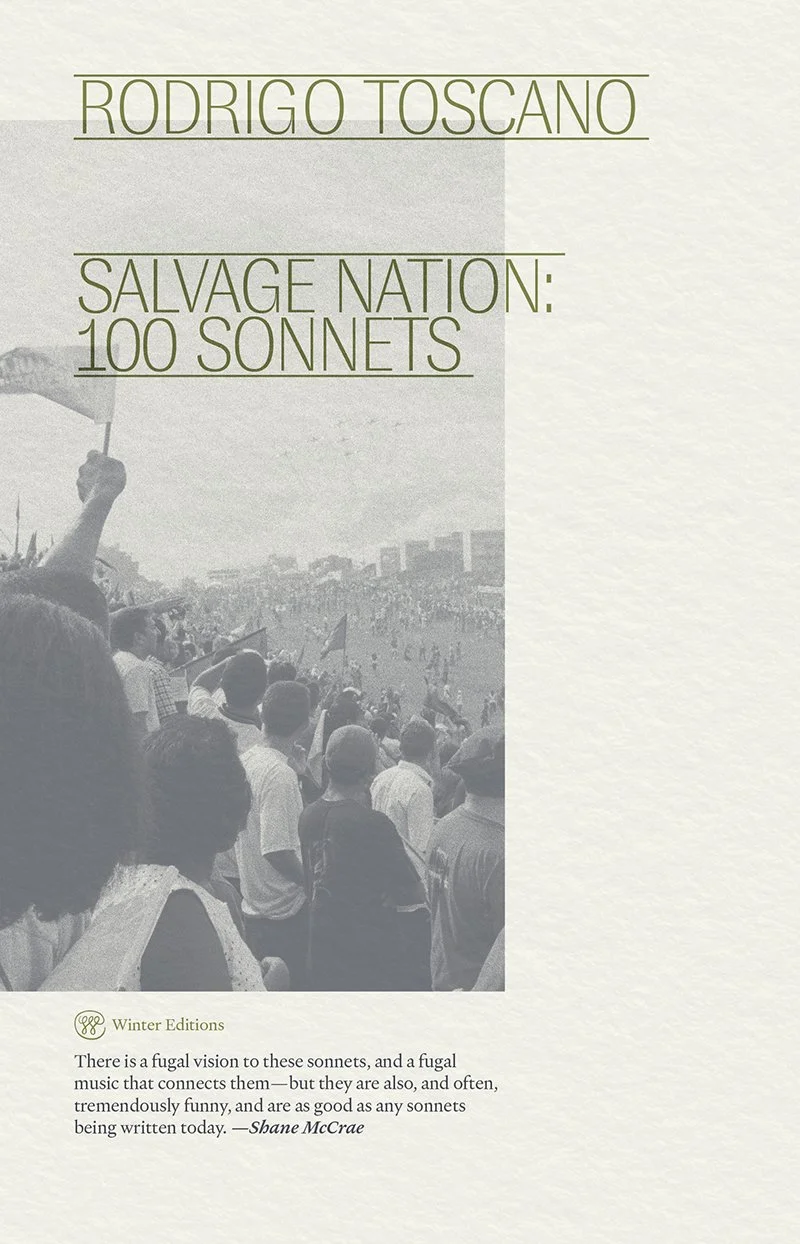
Salvage Nation: 100 Sonnets
In a tour-de-force of one hundred sonnets, Rodrigo Toscano blends geopolitical critique with the challenges of media-saturated life, offering a sharp, sustaining read for those overwhelmed by the twenty-first century’s complexities.
Renowned for his contrapuntally rich texts, in his thirteenth book of poetry, Toscano navigates the nuances of lived experiences filtered through volatile national realities, all the while remaining open to premonitions of cosmic existence. Divided into four equal sections of twenty-five sonnets (each composed with fourteen ten-syllable lines), Salvage Nation voices the muted moments of the present to reveal the historical contradictions shaping our future, and suggest that national regeneration can lead to an international flourishing of alternative possibilities.
Ideally, a sonnet sequence both rebuilds and contains a world in a succession of small spaces. Traditionally, these spaces have constituted small worlds suggesting a larger world. Rodrigo Toscano’s Salvage Nation: 100 Sonnets constitutes a large world, and again and again suggests its new, unnatural, troubling smallness. There is a fugal vision to these sonnets, and a fugal music that connects them—but they are also, and often, tremendously funny, and are as good as any sonnets being written today.
—Shane McCrae
Empires decline; the sonnet persists. Here, in the form of salvaged packaging for the most unsparing of critiques. Around the time I was reading Toscano’s incisive sonnets, I encountered, on two separate occasions, vans from Roman Empire Logistics handling Amazon dropoffs. Call it a vibe thing. Or a spin on that old adage about tragedy followed by comedy, even though it’s all volta now. As the poet reminds us, “some sonnets manage to scamper away … yet others form a sort of defense line.” Consider yourself recruited.
—Mónica de la Torre
In Salvage Nation, sonnets (those well-trodden little songs) become as practical as a nut and bolt, as puissant as a bullet. This collection brazenly fuses homologies of all time, all space, all material: local to global, industry to leisure, history to now. No lyrical masking, no posturing of niceties, just fourteen sharp-toothed, sweet-tongued lines in the reader’s mental blender: ontologies pulverized, made fresh and easy-to-swallow. By dint of Brechtian-channeled forces, here’s a salvage poetics sponging up our deranged zeitgeist as only Toscano can distill it. As the rag-and-bone powers that be are killing us, this pragmatic music and its voltas offer a current spec sheet insisting somewhere, somehow, their plug can be pulled.
—Henry Goldkamp
Equally critical of a decomposing empire as it is of literary worlds, Salvage Nation craftily works through material realities that are simultaneously berserk, unpleasant, and full of the hilarity found in their enforcement. Toscano doesn’t wring his hands at our odd complicities and deracinated alibis crumbling at every turn, he simply asks the reader to be with the relentlessly unfolding contradictions, to lend a hand in their detection. Filleting both the self-righteousness of “ethics cranks” and the anti-collectivism of the imperial “I,” these sonnets are instead thinking about the “we;” what that might be, and how poetics might help it happen, while all the time remaining “against, againstish, and part of it.”
—Kai Ihns
Like other poets whose voices are entwined in empire and crumble, such as Walt Whitman or Natalie Diaz or Lorine Niedecker or Anne Waldman, Toscano shows up to proclaim, navigate, endure, and cast forward to the readers and their hunger. A poet of place, time, culture, the vortex of centering what’s raw, real, grazing our face…. [his] work is insurmountably wide ranging.
—Greg Bem, North of Oxford
Rodrigo Toscano is the author of twelve previous books of poetry, including the National Poetry Series finalist WHITMAN. CANNONBALL. PUEBLA. (Omnidawn), The Cut Point (Counterpath), and The Charm & The Dread (Fence). His poetry has appeared in more than 20 anthologies, including Best American Poetry and Best American Experimental Poetry. His book of performative poetry, Collapsible Poetics Theater (Fence) was a National Poetry Series selection. Toscano received a NYSCA/NYFA Artist Fellowship in Poetry and the Edwin Markham Prize for Poetry. Toscano’s poems have been translated into French, Dutch, Italian, German, Portuguese, Spanish, Norwegian, and Catalan. He works for the Labor Institute in conjunction with the United Steelworkers and serves on the board of the New Orleans Poetry Festival and Fence. Originally from San Diego, Toscano lives in New Orleans.
Paperback
128 Pages
5.12 x 7.95 inches
Edition of 1250
ISBN 978-1-959708-23-0
November 5, 2026
English
Distributed by Asterism Books (US) • Public Knowledge Books (UK)
Genre: Poetry
a note on the text
While the first twenty-five sonnets in the section, “Of Polis” explore American national self-understanding in early-stage late empire, the section, “What It Felt Like” deepens an eerie apprehension of the sweeping historical changes rumbling beneath our feet. The sonnets in “The Praxis” home in on the material conditions of contemporary poetry production, weaving its stumbles and surges into witty vignettes. Sonnets seventy-five through one hundred in “Working the Quirk” give free play to the downstream cultural effects of an increasingly dystopic Capitalist landscape.